
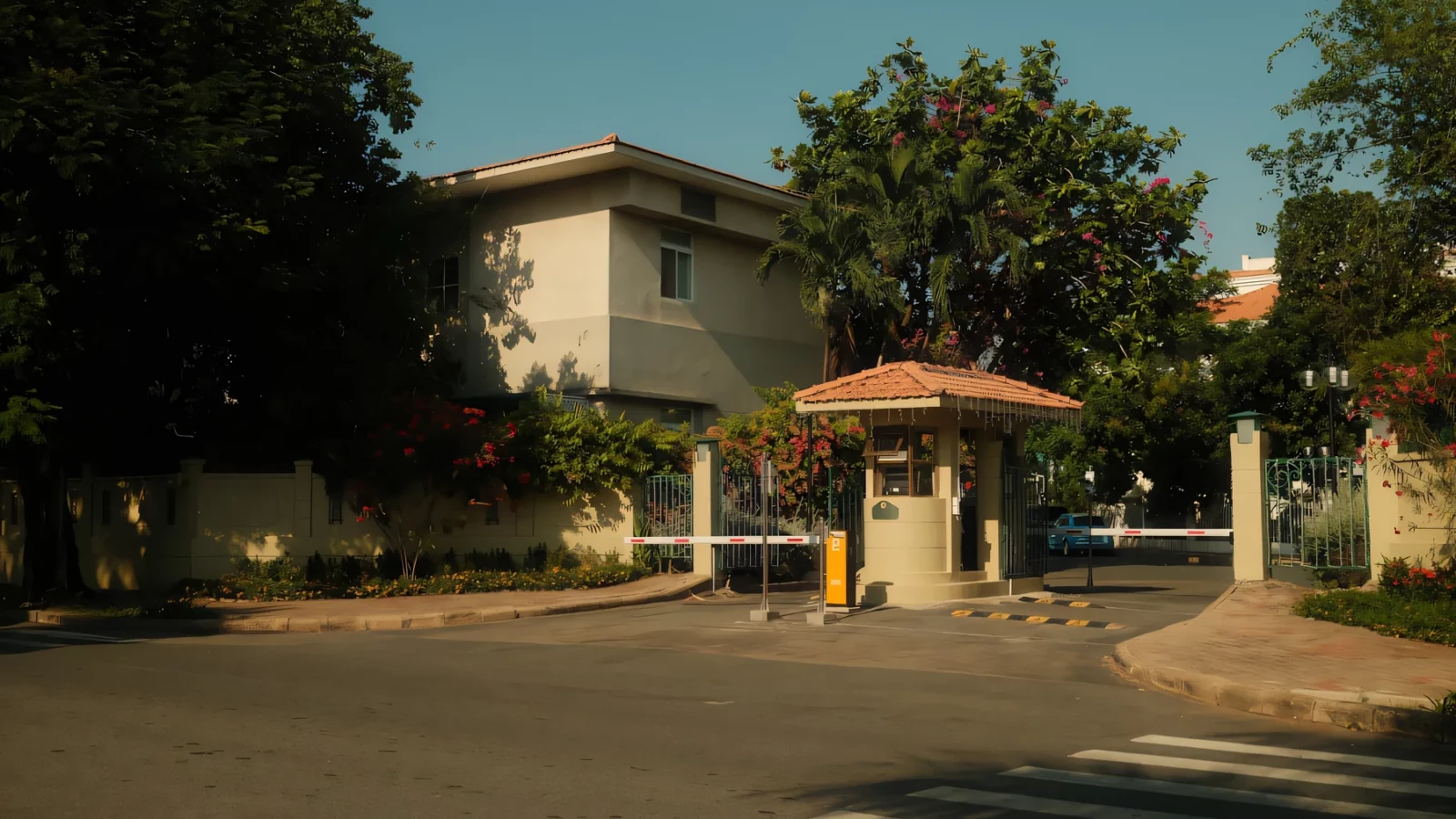
South Africa’s estate boom is usually sold as a property story, but it is really a referendum on trust. More households are choosing to live behind gates because the outside world feels harder to predict, police, and fix.
The appeal is plain enough if you live here: a guarded entrance, a neat road, a clubhouse, a pool, children on bicycles, a lawn that gets cut on schedule, and lights that stay on when the suburb next door goes dark. People are buying a house, but they are also buying a version of daily life that feels managed.
The house comes with a promise
Security estates, gated communities, and lifestyle complexes work because they solve several problems at once. They offer access control, private guards, cameras, fencing, patrols, and enforced rules. They also offer shared space that does not look abandoned. Streets get swept, verges get trimmed, and common areas are kept in order. Parents can let children play outside without the usual calculation about risk.
That package has become especially attractive for young families. A place where a child can walk to a friend’s house, cycle past the clubhouse, and come home without a parent holding their breath is no small thing. In a country where ordinary neighborhood life often feels like a series of small precautions, the estate sells the old idea of normality back to residents at a premium.
The price tag is part of the story. Entry-level homes in these developments often start around R1.5 million to R2 million, before levies and other costs. That keeps the model out of reach for most households. The boom is not broadening access to safety and order; it is sorting who gets them.
The real product is control
The headline features of estate living are visible from the street, but the deeper draw is emotional. Buyers are not only trying to protect property; they are trying to reduce noise in their lives. They want predictable routines, familiar neighbors, clean public space, functioning infrastructure, and fewer moments where a simple daily task turns into a small confrontation with disorder.
Many estates feel like miniature versions of a better-run city. The roads are maintained privately. Waste is collected on a schedule that works. Some large developments add backup power, boreholes, water treatment, fiber, and other systems that residents no longer trust public providers to deliver reliably. In places such as Waterfall City, the estate even starts to resemble a private municipal zone. The point is continuity, not only comfort.
There is also status in the arrangement, whether people admit it or not. A gate can be a practical barrier and a social signal at the same time. It marks a line between those inside and those outside. For some residents that is a nuisance, but for others it is part of the appeal. The address itself says something about money, taste, and what kind of life a family can reach.
The private city inside the public one
The growth of estate living tells a blunt story about public services. Potholed roads, unreliable streetlights, neglected parks, irregular waste collection, theft of municipal infrastructure, and power cuts have pushed more residents toward private answers. When the state cannot keep a neighborhood clean, safe, and functioning, people who can afford it stop waiting.
That shift has consequences. A household in an estate still pays municipal rates and taxes, then pays levies to the homeowners’ association, and often pays private security too. The same family finances the public system and the parallel one built to replace it. That double payment has become so normal that people now describe it as the cost of living in a country where the basics arrive unevenly.
The private estate becomes more than real estate; it becomes a small, managed substitute for the larger civic contract. Residents no longer depend on public space in the same way. They do not need the park across the road if the estate has its own green belt. They do not need the municipal playground if there is a clubhouse and a pool. They do not need the local street to feel safe if the internal roads are controlled by guards and cameras. The old public world gets bypassed one function at a time.
Separation with good landscaping
The uncomfortable part is that estate life can make separation feel tasteful. Walls, guards, and levies sound cleaner than segregation, which is really what sits underneath the model. Wealthier and middle-class households retreat into enclaves where their daily contact with poorer neighbors becomes thinner and more accidental. That limits exposure and friction, but sometimes friction is how a shared society learns to notice itself.
Children who grow up inside these walls often inherit a different map of the country. Their schools, friends, sports, transport habits, and leisure spaces tend to cluster around privately managed comfort. Children outside the gates live with a different set of calculations about distance, transport, safety, and access. The gap is not abstract; it shows up in everyday ease.
The country has lived with spatial inequality for generations, so none of this arrives from nowhere. Estates did not create that divide, but they have given it a cleaner architecture. The barriers are newer, but the logic is older.
What people are building around themselves
The rise of these developments says something uncomfortable about where confidence now sits. Many South Africans are no longer asking how to repair the shared environment first. They are asking how to build a workable life beside it. That is a rational response to bad service, crime, and administrative drift. It is also a retreat from the idea that public life can still be made to work for everyone.
That is the social meaning hiding inside the boom. Residents are choosing security, routine, and controlled space because those things feel scarce elsewhere. They are choosing an environment where rules are visible, upkeep is consistent, and risk is narrowed. They are choosing a life that feels assembled rather than endured.
The country being built around these walls is not a fantasy of escape. It is a patchwork of private solutions where those with means buy order one levy at a time. The gates keep out crime, but they also keep in a certain idea of the good life, one that is increasingly local, managed, and paid for twice.