The loudest stories about the country usually arrive with a bill attached, a court date, or a crisis. The public mood gets flattened into scandal, strain, and survival. That picture is real, but it is also incomplete. The deeper story is stranger, older, and more interesting: a place with three capitals, ancient human fossils, penguins on a tourist beach, a desert that erupts in colour, and a language map so crowded it finally had to make room for sign language too.
The daily news cycle is good at telling you what is broken. It is much worse at telling you what is unusual. Some of the most defining facts about the country have nothing to do with politics or panic. They sit in its geology, its wildlife, its coastlines, its history, and the way people speak to one another.
A country built on compromise and deep time
Pretoria, Cape Town, and Bloemfontein are not a gimmick. They are the leftover architecture of political bargaining. When the Union was formed in 1910, nobody could agree to hand too much power to one city, so the state was split across three of them. Pretoria runs the executive, Cape Town handles Parliament, and Bloemfontein houses the Supreme Court of Appeal. That setup still looks odd on paper, but it tells you something plain about the place. Power here has never sat neatly in one chair.
The Cradle of Humankind makes all the present-day noise look briefly small. The fossils found there push human history back millions of years. The site has produced some of the oldest human ancestors ever found, including famous remains such as Mrs Ples and Little Foot. It is hard to overstate what that does to the national story. This is a landscape tied to the earliest chapter of human existence, not just a modern state with a messy politics file.
Headlines often leave out this part. A country can be fighting over budgets, coalitions, policing, and unemployment in the morning, while also sitting on caves that rewrote the story of where we came from. Those two things are not in conflict. They are the same country.
Wildlife does not wait for the news
Some regions have more wild animals than people, which sounds like a promotional line until you look at the map. Kruger National Park alone covers about 19,485 square kilometres, roughly the size of Wales. That scale matters. Wilderness here is physical, massive, and still stubbornly alive; it is not just a conservation slogan.
Kruger is the clearest example, but it is not the only one. The country also offers what safari marketers like to call the Big 7, not just the Big 5. Lions, leopards, elephants, rhinos, and buffalo get the attention, but the wider draw includes whales and great white sharks too. That is a ridiculous amount of dramatic wildlife for one place to carry, which is probably why people keep coming back for another look.
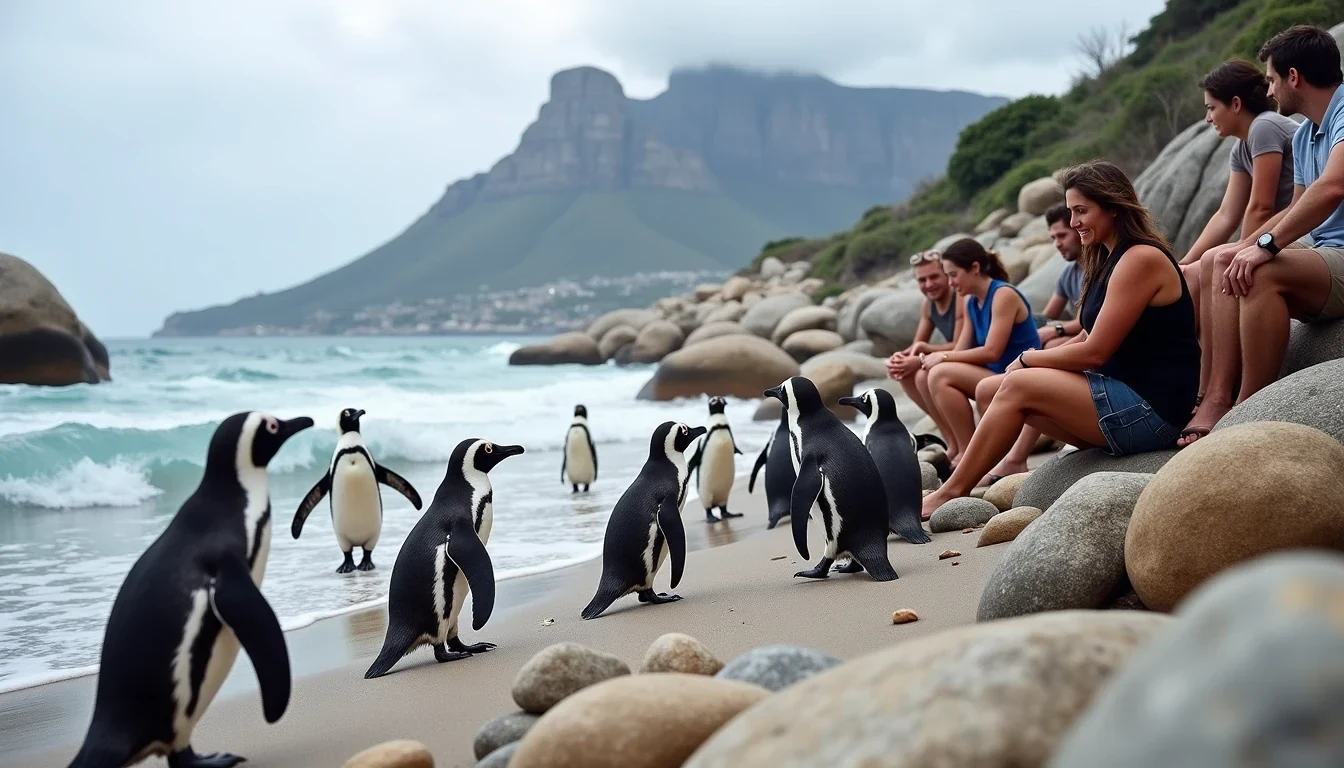
The coastline and the veld confuse expectations. Boulders Beach has African penguins, which is absurd in the best possible way. Namaqualand can turn into a rainbow desert when the flowers come through, a seasonal burst of colour that makes the dry land look almost theatrical. None of this fits the standard foreign idea of a country described mainly through service-delivery protests and political drama. Yet this is the same place.
The Cape Floral Kingdom sharpens the point. It is the smallest of the world’s six floral kingdoms, but also the richest. It occupies less than 0.5% of Africa’s area and still contains over 9,000 plant species, with most of them found nowhere else. It has more plant species than the UK and New Zealand combined. That is not a footnote. It is a biological superpower.
The coast does not behave like a stereotype
Jeffreys Bay is one of the world’s serious surf stops, not a local curiosity. J-Bay has a reputation that travels far beyond the Eastern Cape because the wave itself is the attraction. Long, fast, and clean, it is the sort of break surfers plan around rather than stumble into. The World Surf League has put it on the map for years, and for the people who care about that scene, it is a bucket-list wave.
That matters because it reveals another side of the place that gets buried under the usual headlines. Tourism here is not only about safaris and wine estates. It also runs through surf culture, coastal towns, and the small economies that grow around them. A wave can carry global attention in the same way a reserve or a fossil site can. The country keeps collecting these seemingly unrelated marvels and placing them in the same frame.
Even the scale of the natural attractions refuses to behave modestly. A park the size of Wales. A floral kingdom richer than two entire countries combined. A coastline with penguins, sharks, and elite surf breaks. These facts are not charming trivia. They make the country harder to reduce to a single mood.
A nation speaking in many voices
Language is where the same pattern shows up again. There are 11 official spoken languages, and since July 2023 South African Sign Language has been recognised as the 12th official language. That decision did more than add another item to a constitutional list. It widened the idea of who counts in public life.
The language setup is a blunt reminder that identity here was never going to be simple. Afrikaans, English, isiNdebele, isiXhosa, isiZulu, Sepedi, Sesotho, Setswana, siSwati, Tshivenda, and Xitsonga already made the country one of the most multilingual states in the world. The recognition of sign language pushed that logic further. If the state is serious about belonging, then belonging cannot stop at speech.
There is also a practical side to this. Language shapes who gets heard in school, in court, in clinics, and in government offices. So when a country adds another official language, it is not performing diversity for a brochure. It is admitting that access has always been uneven, and that inclusion has to be built into the system, not shouted about after the fact.
This is what gets missed when the day’s headlines dominate the frame. The loud stories are real. But they do not cancel the other facts. Three capitals. Ancient fossils. Wildlife that outnumbers people in some places. A floral kingdom that punches far above its size. A wave surfers fly across the planet to ride. A park so large it needs a foreign country for comparison. Twelve official languages if you count sign language, which the state finally did.
The country is not hard to define because it lacks a character. It is hard to define because it has too many.